What is Hard Water?
Hard water is caused by water absorbing dissolved minerals as it moves through the ground.
Hard water is caused by water absorbing dissolved minerals as it moves through the ground. Here's how it happens:
The process:
- Rain falls as naturally soft water (slightly acidic due to dissolved CO₂)
- It seeps into the ground and flows through rock and soil
- As it passes through certain rock types, it dissolves minerals — mainly calcium carbonate and magnesium carbonate
- These dissolved ions remain in the water as it's collected in aquifers, rivers, and reservoirs
Rock types that cause it:
- Limestone and chalk are the main culprits; highly soluble and rich in calcium carbonate
- Dolomite contains both calcium and magnesium carbonates
- Gypsum contributes calcium sulphate
Two types of hardness:
- Temporary hardness — caused by dissolved calcium bicarbonate. Can be removed simply by boiling the water, which causes limescale to precipitate out (hence the furring in your kettle)
- Permanent hardness — caused by calcium sulphate and other salts that don't break down with boiling; requires other treatment methods like water softeners or ion exchange
Geography is key — areas built on chalk and limestone (like much of the Midlands, East Anglia, and South East England) have hard water, while areas with older, harder igneous rock (Scotland, Wales, the Lake District) tend to have soft water.
Hard water is water that contains high concentrations of dissolved minerals, primarily calcium and magnesium ions.
Why it is a problem:
- Limescale buildup — leaves white, chalky deposits on kettles, pipes, taps, and appliances, reducing their efficiency and lifespan
- Soap inefficiency — reacts with soap to form a sticky "scum" rather than a good lather, meaning you need more soap or detergent
- Skin and hair — can leave skin feeling dry and hair feeling dull or stiff after washing
Hardness is measured in milligrams per litre (mg/L) or "degrees of hardness." Water above roughly 120–180 mg/L is generally considered hard.
Soft water, by contrast, has low mineral content and lathers easily — common in areas with granite bedrock (much of Scotland and Wales, for example). The East and South of England tend to have notably hard water due to chalk and limestone geology.
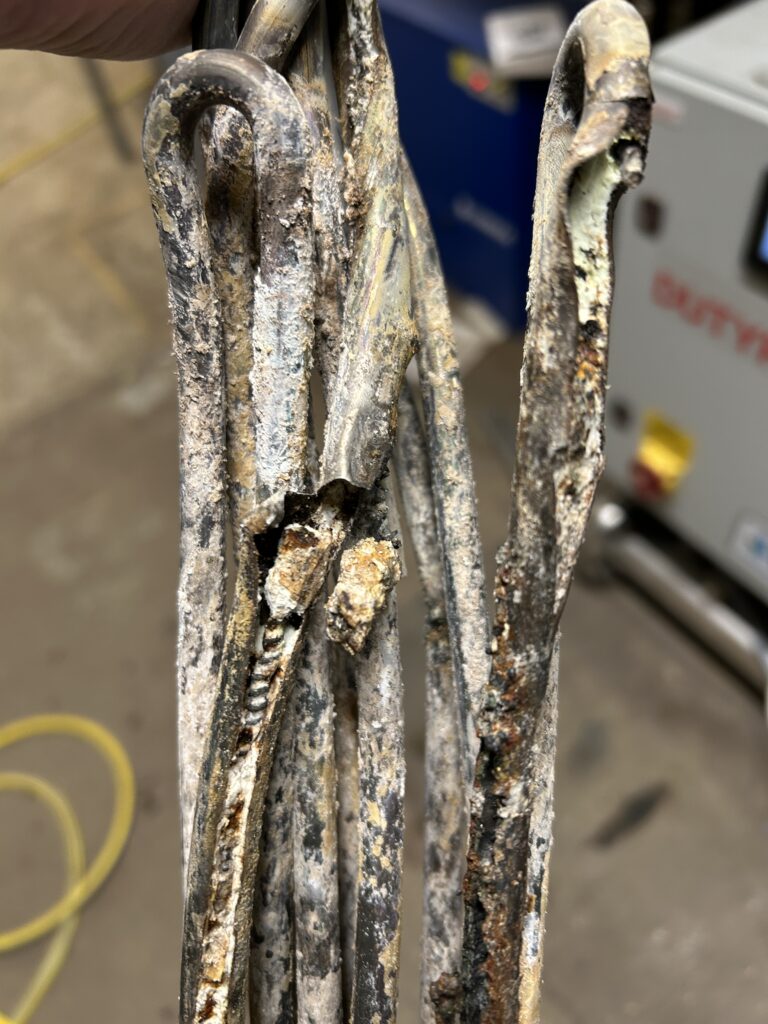
Hard water isn't a health concern — the calcium and magnesium it contains are actually beneficial minerals — but it's a practical nuisance in the industrial process, doing this to your heaters -
Watt density and it's Importance for Heating Hard Water.
Put simply, the higher the watt density, the higher the sheathe operating temperature, and the quicker & more efficiently the crust of Calcium and Magnesium builds up.
For a more detailed explanation of Watt Density, click here.
If we can loop the elements -
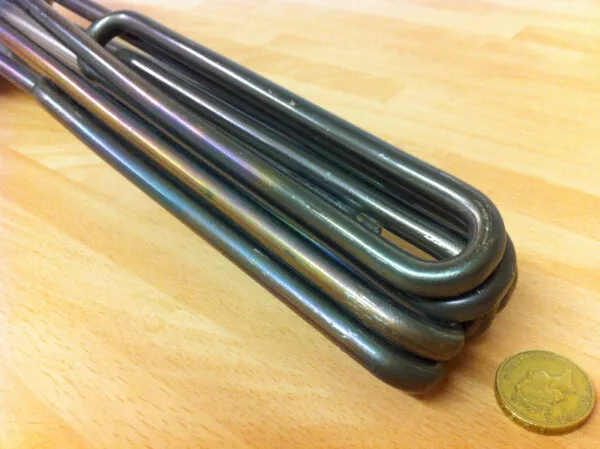
...rather than just having U bent elements -
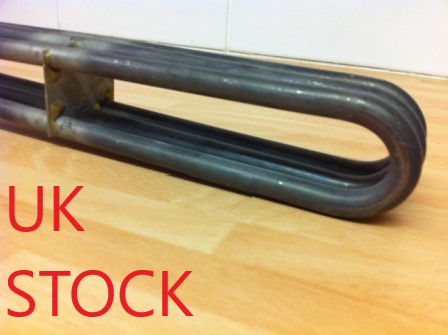
...we can fit almost twice as much element into the available space, thus massively reducing the watt density.
We can do this ith our 8mm diameter elements on screwplugs 2"BSP and above. Sadly, on 1.75"BSP and below, the head simply won't accommodate the elements, so we are restricted to only U bent elements. Which is a great shame, as the Domestic Standard at 1.5"BSP, and the Unvented Cylinder Standard of 1.75"BSP suffer this unecessary restriction. The Industrial Standard of 2.25"BSP thankfully does not!
We will always push to use the MAXIMUM available immersed length. Our Stock Heaters available off the shelf are a Best Fit compromise. But longer, bespoke heaters, manufactured in the UK in weeks rather than months, will get you the best possible watt density, and thus working life.
What Sheathe Materials Best Suit Hard Water?
Feel free to copy/paste the header into your Ai of choice, it will confirm our findings and beliefs.
The best immersion heater sheath material for hard water depends on your water hardness level, but here's the straight answer:
For most industrial hard water applications, Incoloy 800 or 825 is the right choice. Here's the full breakdown:
- 316L Stainless Steel is fine for mildly hard water (under ~200 mg/L). Affordable but vulnerable to limescale build-up and chloride pitting in harder conditions.
- Incoloy 800 is the sweet spot for most hard water. Better scale resistance, superior corrosion resistance, handles higher operating temperatures. This is what your stock range already uses — the right call.
- Incoloy 825 adds molybdenum for better resistance to sulphuric and chloride-heavy water. Ideal for 400–600 mg/L or aggressive chemistry.
- Titanium is best suited for extreme hardness (600+ mg/L), seawater, desalination, or geothermal water. Expensive but unmatched longevity in punishing conditions.
- Hastelloy C-276 — for highly acidic or chemically aggressive hard water. The last resort before exotic alloys, but outstanding where nothing else works.
The short version: if you're in doubt, specify Incoloy 800. It outperforms stainless in virtually every hard water scenario without the cost of titanium.
Which is fortuitous, as that is what we specialise in!
Are immersion heaters expensive?
At Immersion Heaters UK, we like to think ours are very reasonably priced. We supply industrial immersion heaters at close to cost price and can deliver all over the UK.
BSP Screwplug Sizes - A Large PITA!

It should be simple.
You measure something, and that is the size.
Not if you are measuring a BSP (Bristish Standard Pipe) screwplug, sadly.
The size was originally based on the inner diameter measured in inches of a steel tube for which the thread was intended. This often causes confusion, as "normal" people think the size refers to the outside diameter of the male thread.
For example, the most common BSP Thread Size for UK Immersion Heaters is 2¼” BSP. If you measure roughly across the threads to check the diameter, it looks closer to 2½”, 2.58″ or 65.7mm, to be precise. Best be using a vernier gauge to be that accurate!
If you ask for a 2½” BSP immersion heater to be made, it will arrive with a thread size of almost 2.96″ or 75.18mm, which will be really annoying as there is no way it will fit, it will be the thread size you asked for but not the size you need. It is the same for all other BSP threads so caution is required.
Here at IHUK we believe prevention is better than cure, so here you go -

- Cut a strip of paper that you can wrap around the thread you want to measure.
- Draw a Line across it with a pen or pencil.
- Wrap the paper strip once around the thread and make a second mark where the paper overlaps the first mark.
- Unwrap the paper and measure the distance between the marks. This should correspond to one of the measurements on C=Circumference (C) mm above.

Why is shipping so expensive?
Long parcels and exotic locations, such as the Ireland, Highlands & Islands, can often prove to be prohibitively expensive with courier companies. We have to cover all bases for web orders, when folks want the convenience of plonking it in a basket & chucking in their credit card details. The website is covered with invitations to "Ring Jamie for a deal" and a conversation really is best. It also removes the issues of "Bits" like stats & compression glands, which we will be sure to ask if you need, thus preventing confusion.
What is the temperature of the sheathe of my element?
It is almost impossible to accurately measure the sheathe temperature of the elements, as the measuring device senses temperature of the medium the element is in, ie, the air, water or oil, rather than the temperature of the stainless steel tube.
The following is as close as we can realistically get, humblest apologies.
| Watt Density | Approx Sheath Temp |
|---|---|
| 5 W/in² | ~150–200 °C |
| 10 W/in² | ~180–230 °C |
| 15 W/in² | ~210–260 °C |
| 20 W/in² | ~230–320 °C |
| 25 W/in² | ~260–430 °C |
Bloody hot, simply put!
Or if you prefer ChatGPT's equally vague version -
Oxidisation within a constant use element.
The element will have been sealed hermetically by silicone or by resin matched to the designed operating
temperature of the application.
We have recently discovered that if an element is well sealed it will operate perfectly well with the seal intact at
variable temperatures, especially if the power is controlled by a thermostat and will generally modulate. However,
a well-sealed, element that operates continuously without modulation of temperature can suffer insulation
resistance problems.
In these situations these insulation resistance problems are not generally related to moisture, as we had always
believed.
It is a problem caused by starvation of oxygen inside the sheath.
A well-sealed element that operates at relatively low temperatures and cycles on and off by modulation with a
thermostat control will be fine with a good seal against the ingress of moisture which we know can cause problems
of poor insulation resistance.
The same element when used at higher, constant temperatures; inside, the resistance wire coil will begin to use up
all of the oxygen between the pores of the MgO powder this is because of the natural oxidation process of the
wire which happens more quickly as the temperature increases. When this oxygen is depleted there is a pressure
drop inside the sheath. If the element has a "breathable" seal that can prevent most moisture ingress, but permit
oxygen to pass through to the powder this will equalise the pressure and replenish the oxygen inside the sheath.
However, if the seal is air tight, no oxygen will be allowed to enter the sheath. The temperature will force the
oxidation process to continue and a change will occur inside the element when all of the available oxygen has
gone. A chemical reaction or process begins; the O in MgO is drawn out and combines with part of the Nickel
Chrome wire or the oxide it is now coated with. This combination forms a kind of semi-conductor within the
powder. Electricity prefers conductors to resistors and as the "conductor" expands from the area surrounding the
resistance coil as it continues to react to the lack of oxygen, it will reduce the clearance distance from the coil to
the sheath and potential will take the route of least resistance to earth.
With good or reasonably reactive protection devices this will cause nuisance tripping and the power will be
disconnected. Where protective devices are designed and installed to be slower acting, as they sometimes should
be at elevated temperatures, the short can cause a flashover which can puncture the sheath and cause
catastrophic failure by "zipping" until the element is destroyed or the current increase is enough to take out a fuse
or other protective device.
We have tried this on many occasions before to re-dry and seal elements that have low IR issues after use in high
temperature applications, as we thought it was probably a damp element issue.
We have discovered after trying and failing to dry out elements. Sometimes the element will not permanently
maintain good insulation resistance because the powder may be permanently changed. Tests may be ok when cold
but can soon fail after going on power.
The properties of the MgO have been changed by the chemical process.
18 November 2018
Our Ref : TPFAY Oxygen Starvation of MgO leading to Low Insualtion Resistance Failure in Sheathed
We found this in a few elements we encountered the problem of irreversible low IR in that were otherwise in
perfect condition. We would carefully cut open the element where we would find black or dark grey powder in a
section of element that failed insulation tests. We would blame contamination of the powder, or the tube or both.
But occasionally the problem would happen when we were certain we had eliminated any possibility of
contamination. After reading and researching we found some text that explained the problem. It suggested that
powder that was found to be dark grey or black from a failed element when cut open would, if it had been
transformed by oxygen starvation, return to white and pure if it was heated in a furnace to over 800c while
exposed to atmosphere.
We tested a section and it worked. Unfortunately this will not work for powder inside a closed element so it
proved the theory but could not reverse the issue.
Often the element must be replaced with a redesigned or specified sealing method.
We must find
• The Element operating temperature
• Does the element remain energised permanently or does it cycle to a control temperature with a
differential of switching
o Please find differential – if known
• The application
• The environment
• The temperature and environmental conditions at the terminals